Replace the try/catch, @Test expected and @Rule annotations with the assertThrows method
Definition:
Developers should use the language constructs to handle exceptions. In practice, we identified developers using the assertThrows method for refactoring the try/catch block, the @Test expected and @Rule annotations.
Example from practice #1:
The following code snippet shows the replacement of try/catch block within the testBadConfiguration test method of the Camel project with the assertThrows method. More specifically, the refactoring consists of the:
removal of the try/catch block (lines 109 - 114, highlighted in red),
addition of the parameters in the assertThrows method (lines 113 - 114, highlighted in green):
the ResolveEndpointFailedException exception class found in the catch statement,
the call for the sendBody production method raising the exception, and
the optional message which explains the assertion.

Example from practice #2:
The following code snippet shows the replacement of @Rule annotation in the UnsynchronizedBufferTest test class of the Accumulo project with the assertThrows method. The test class contains the ExpectedException rule, which is used by the testByteBufferConstructor through the @Rule annotation to check whether the exception behaves as expected. The refactoring consists of the:
removal of the @Rule annotation (lines 35 and 36, highlighted in red) in the class;
removal of the expected exception from the method (lines 57 - 59, highlighted in red);
addition of the assertThrows method in the test method with the parameters:
optional message that explains the assertion;
the ArrayIndexOutOfBoundsException exception class found in the thrown.expect method;
the call for the readBytes production method raising the exception (lines 54 - 58, highlighted in green).

Example from practice #3:
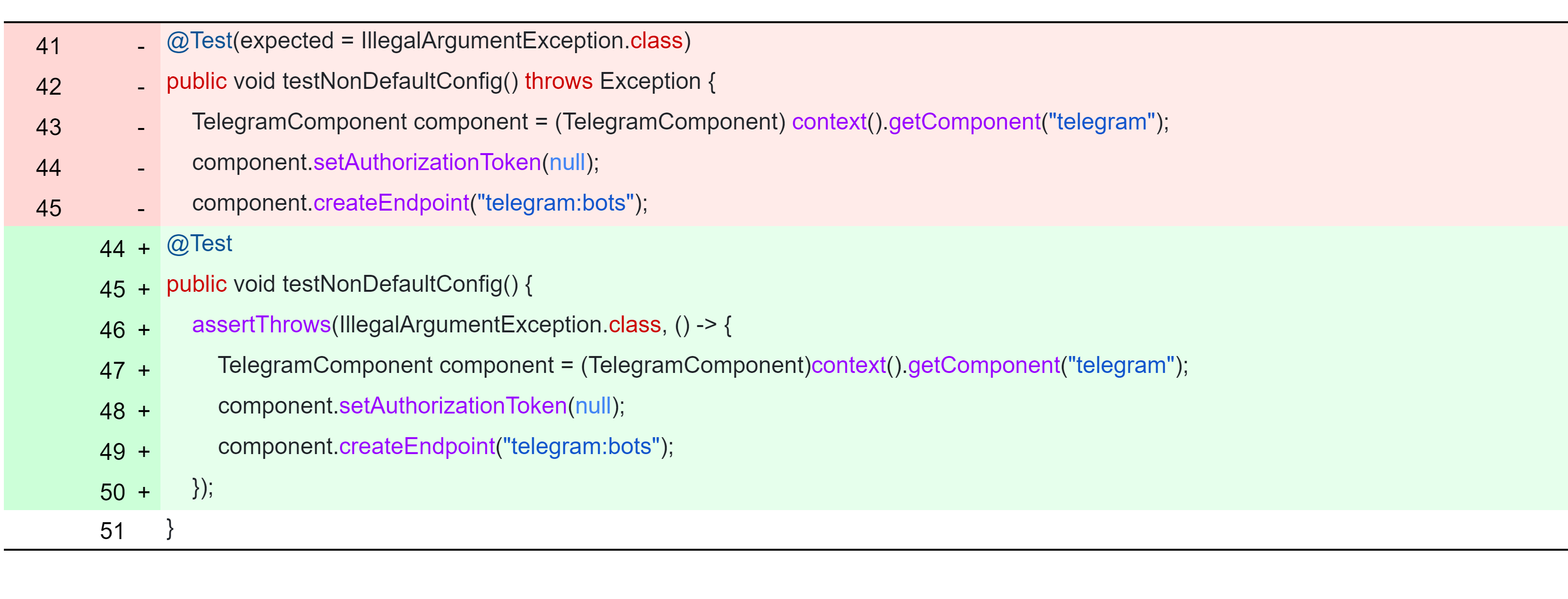
The following code snippet shows the replacement of @Test expected annotation of the testNonDefaultConfig of the Camel project with the assertThrows method. The test method uses the @Test expected annotation to handle the exception (line 41, highlighted in red). The refactoring consists of the:
Removal the @Test expected annotation;
Addition of the assertThrows method with the parameters:
the IllegalArgumentException exception class found in the @Test expected annotation (line 46, highlighted in green),
the statements raising or not the exception (44 - 51, highlighted in green).